toqe → Essay
Essay
I built the freelance app I couldn’t buy
Ten years into freelancing, I could model a photoreal car in my sleep, and I still couldn’t answer the only question that ever kept me up: if nothing else books, when do I run out of money?
I’m a freelance 3D artist. Studios book me in day-rate blocks — sometimes six weeks out, sometimes on a Thursday for a Monday start. Payment arrives on net-30, which really means net-45, counted from whenever I remember to send the invoice. My income doesn’t arrive as a salary; it arrives as weather.
For years I managed that weather in Notion. A projects database with a status for every stage. An expenses database. A studios database. Formulas doing their best. It was a genuinely good system, and I say that as the person who rebuilt it four times. But it had a flaw I couldn’t fix with another rollup: it recorded my business, it didn’t simulate it. It could tell me what I’d invoiced. It couldn’t tell me what my bank balance would look like in February, given the two jobs on hold, the one awaiting payment, the VAT quarter in between, and the trip I’d promised my family. So I kept a spreadsheet on the side for that, and I checked it the way you check a phone — compulsively, and never once feeling better.
The tools I tried to buy were all built for a different freelancer: proposals and contracts, retainer clients, a dashboard with my logo on it in someone else’s cloud. None of them knew what a first hold was. If you freelance for studios, holds are the whole game — soft reservations that studios confirm or release late, stacking and clashing while you smile and say “should be fine.” No tool I found treated a hold as a real thing with a date and a probability and a consequence.
So I did the thing you’re not supposed to do, and built it myself.
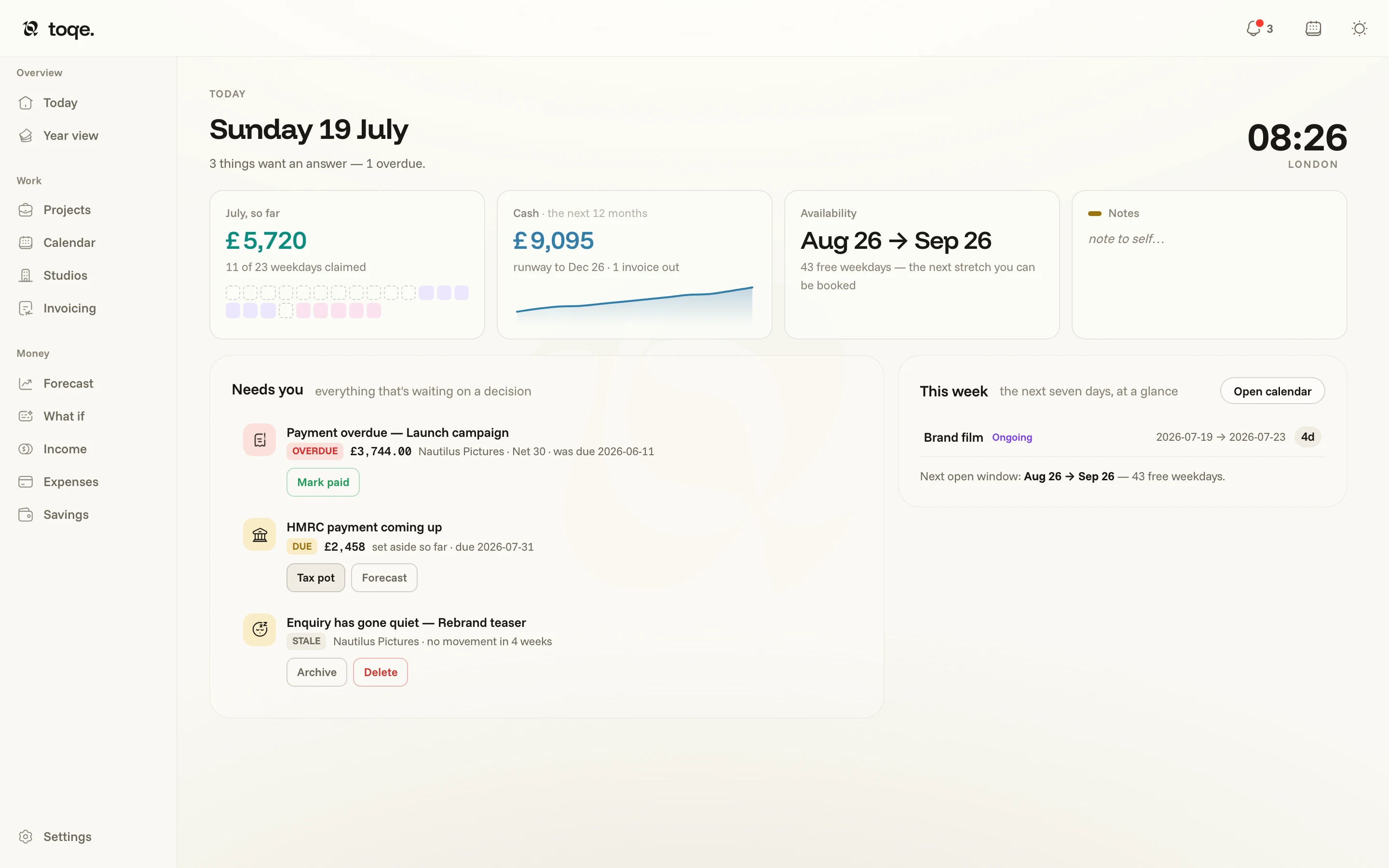
toqe opens on a tab called Today. On it, one number matters more than the rest: runway. toqe takes every booked day, spreads each project’s money across its weekdays, applies my invoice lag and each studio’s net terms, subtracts my real expenses and what tax quietly claims — and tells me, plainly: runway to March, two invoices out. When a hold confirms on the calendar, the runway extends. When I book a holiday, it shortens honestly. That single cause-and-effect changed my relationship with money more than any budgeting advice ever did. The anxiety, it turns out, was never about the number being low. It was about the number being unknown.
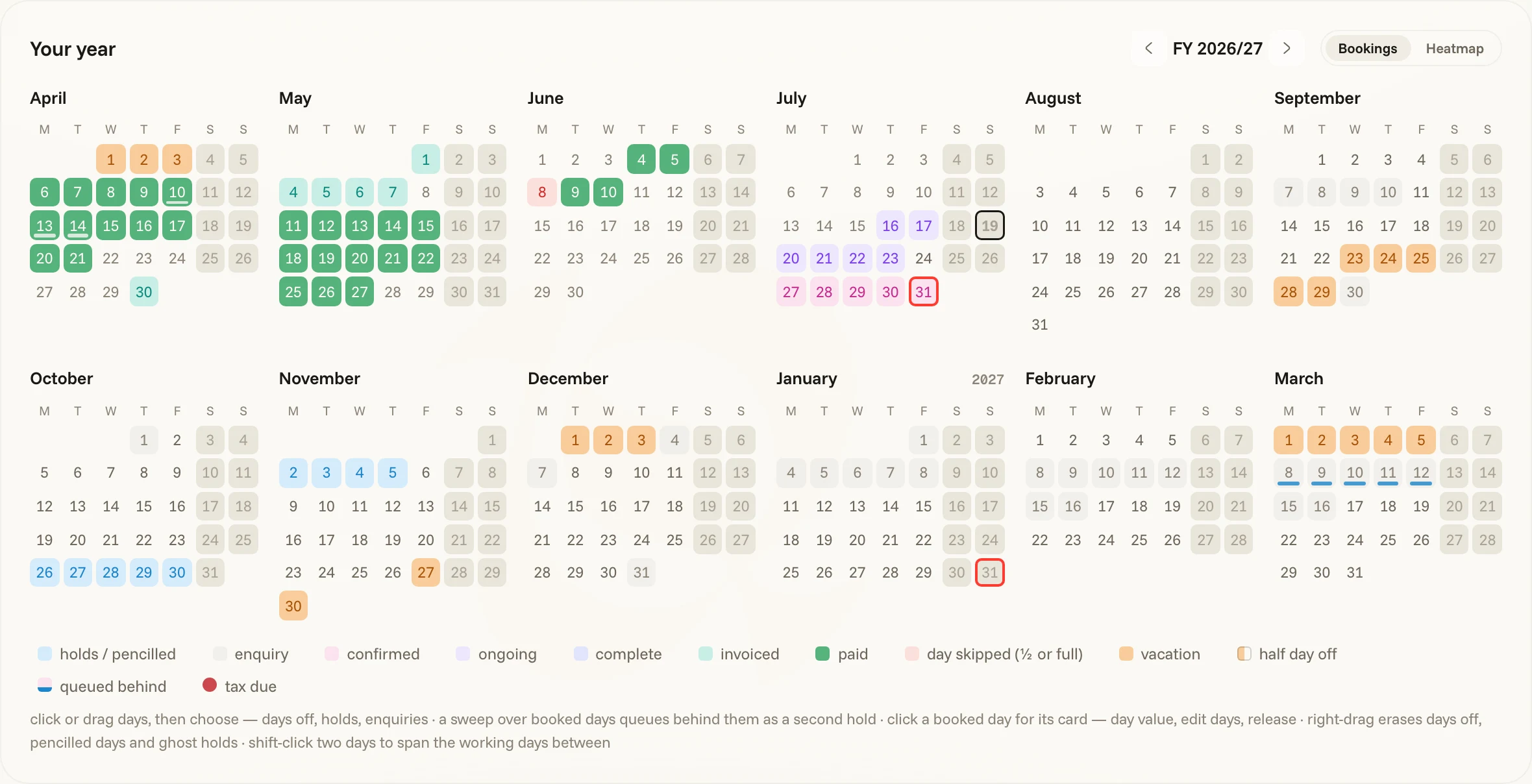
Holds are first-class citizens. I paint them on the calendar; toqe watches them. Two first holds overlap — it tells me before the awkward email. A hold starts Monday and nobody has confirmed — it nudges me on Thursday. A confirmed job collides with days I’d blocked off — it says so, quietly, in a bell that only counts things that genuinely need a decision. The copy in that bell was written under a rule I gave myself early: no orders, no drama. The app’s happiest sentence is “Nothing needs you — the day is yours.”
There’s one decision underneath all of it that I want to be explicit about, because it’s the reason I’d trust toqe with my own numbers, and I built the thing. toqe has no server. There’s no account. Your entire financial life is one file that lives on your own disk — mine sits in Dropbox, which makes Dropbox my sync and my backup and my version history. If I get hit by a bus, or simply get bored, your data doesn’t sunset with a farewell email. It’s a file. You have it. That’s also why toqe is a one-time purchase and not a subscription: it’s a tool, and you should own your tools.
Notion, for what it’s worth, is still welcome. My old databases — projects, studios, expenses — walked in as CSV exports, so a decade of history came along for the ride. The door in is wide open; there is deliberately no door that leads your data anywhere else.
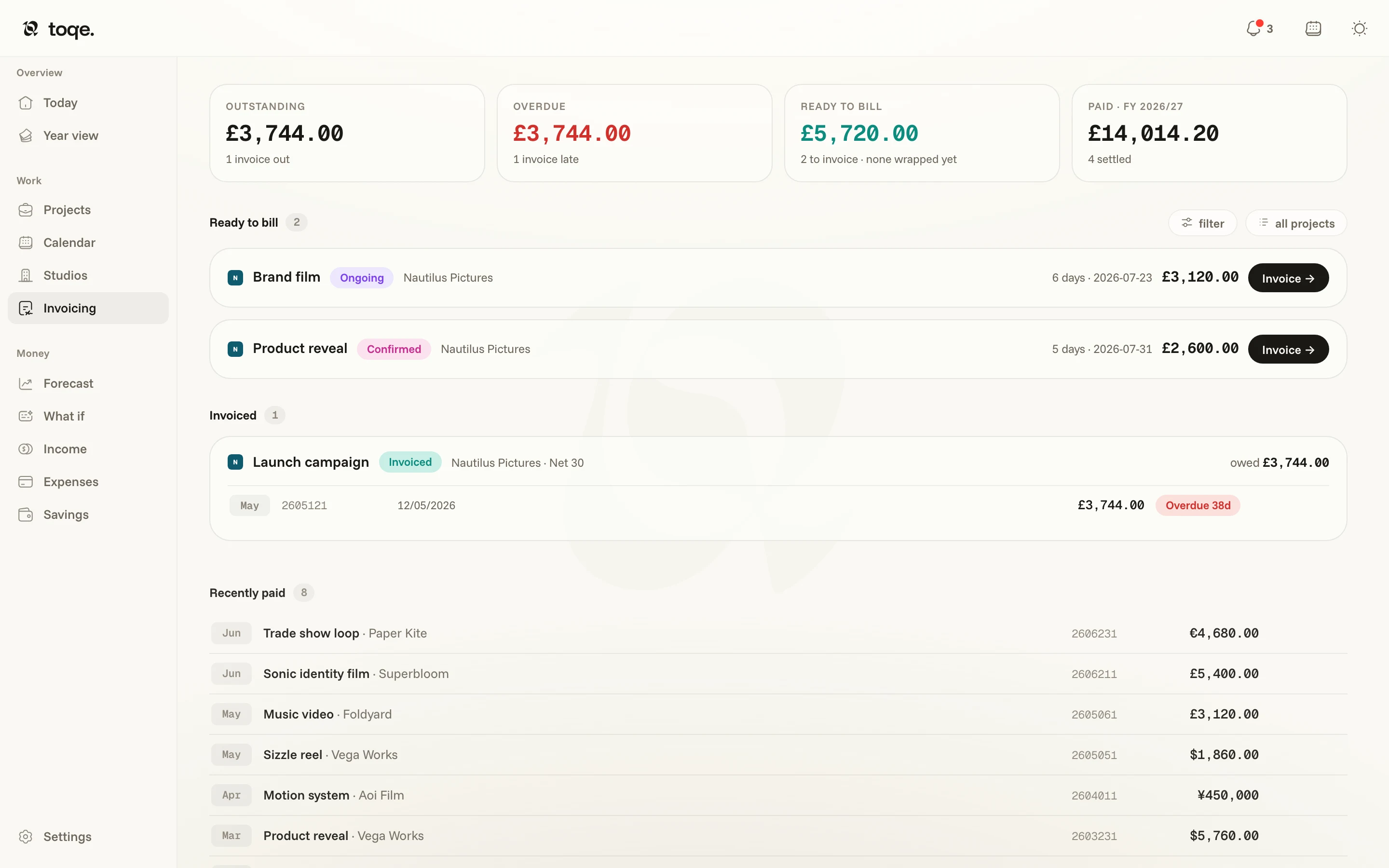
Even the invoice got the treatment. It’s a real PDF with real, selectable text, set in the same sheet I’d been laying out by hand for years — logo, signature, bank details per currency, a thank-you at the foot. It goes from “job’s done” to “sent” in a minute, which matters, because every day an invoice sits unsent is a day added to the runway math for free. And underneath the page a person reads, every export is a compliant e-invoice — Factur-X, XRechnung for Germany, signed Facturae for Spain — because that wave is coming for all of us.
toqe is opinionated on purpose. It’s built for freelancers who get booked in day rates and holds — motion, 3D, VFX, edit, colour. It started GBP-first, because I am: it knew the 6 April year and the HMRC payment cliffs in January and July before it knew anything else. It has since learned to speak nine more countries the same way — pick where you pay tax and the set-aside, the year, even the word for VAT follow. It’s single-user by design; there is no team plan and there never will be. If your freelancing looks like proposals and retainers, there are good tools for you already. This one is for us.
There’s a live demo with sample data — no signup, nothing saved, just poke it: toqe.pro/demo/. If it answers your version of the 3 a.m. question, the desktop app is waiting.
— Rolando